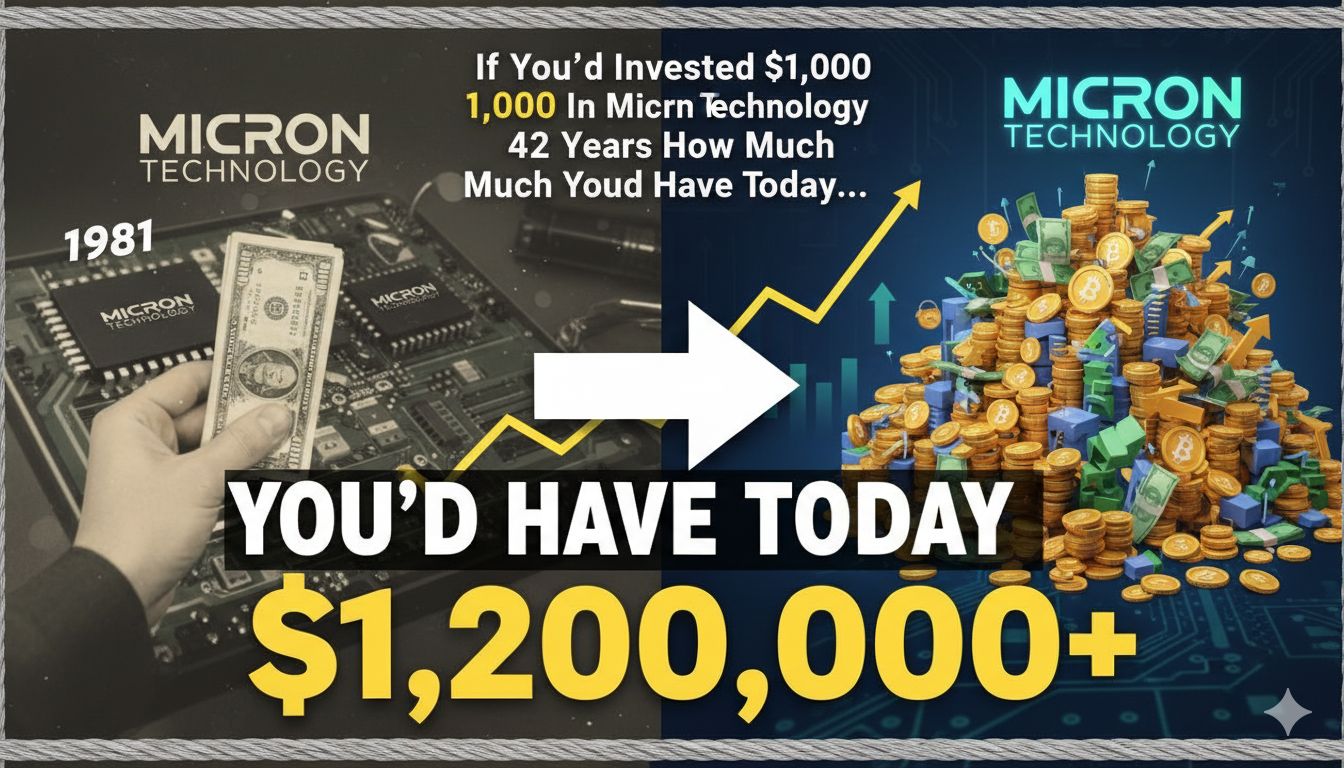
“A $1,000 stake in Micron Technology back on its 1984 IPO day would have grown to roughly $322,000 today with dividends reinvested, delivering a cumulative total return exceeding 32,000% and an annualized growth rate near 15% over the period, underscoring the company’s transformation from a small memory player into a key force in semiconductors amid persistent industry cycles and recent AI-driven demand.”
Micron Technology’s Long-Term Investment Performance
Micron Technology began trading publicly on June 1, 1984, at a split-adjusted opening price around $1.35 per share. An initial $1,000 investment at that time would have purchased approximately 740 shares on an adjusted basis. Today, that same position, accounting for all stock splits, dividend payments, and reinvestment, would be valued at approximately $322,000. This represents a total return of +32,147% from the IPO date through late January 2026, with an annualized return of about 14.87%.
The growth has not been linear. Micron operates in the highly cyclical memory chip sector, where demand for DRAM and NAND flash fluctuates sharply with personal computers, smartphones, servers, and now artificial intelligence applications. Multiple boom-and-bust periods have shaped the stock’s trajectory, yet holding through the volatility has produced substantial long-term gains for patient investors.
The Early Years and Path to Public Markets
Founded in 1978 in Boise, Idaho, Micron initially focused on semiconductor memory products during a time when the industry was dominated by Japanese manufacturers. The company went public in 1984 amid a push to expand production capacity and compete globally. Early years saw modest pricing, with adjusted share prices hovering below $2 for much of the 1980s. The stock experienced gradual appreciation through the late 1980s and early 1990s as personal computing demand grew, but it remained sensitive to global supply gluts and pricing pressure.
Decades of Cyclical Swings and Recovery
The 1990s brought stronger momentum as Micron benefited from the PC boom. Adjusted prices climbed steadily, though periodic downturns—such as the Asian financial crisis impact in the late 1990s—caused sharp pullbacks. The company executed several stock splits, including multiple 2-for-1 events that increased share count and improved liquidity for investors.
The early 2000s tested resilience. The dot-com bust and subsequent oversupply in memory chips drove severe declines, with adjusted prices dropping to pennies in some periods. Recovery began mid-decade as NAND flash demand surged with mobile devices. Micron expanded into NAND through joint ventures and acquisitions, positioning itself as a major supplier for smartphones and solid-state drives.
The 2010s featured dramatic swings. Massive gains in 2017-2018 reflected strong memory pricing, followed by steep corrections in 2019 due to oversupply. The COVID-19 era initially disrupted supply chains but later fueled demand for electronics, driving another upcycle. Adjusted prices multiplied several-fold during peak periods.
Recent Performance and the AI Catalyst
The most recent chapter has been fueled by artificial intelligence. Micron’s high-bandwidth memory (HBM) products have become critical for AI accelerators, particularly those used by leading cloud providers and GPU manufacturers. Demand for advanced DRAM and NAND in data centers has pushed pricing and volumes higher. In 2025, the stock posted extraordinary annual gains exceeding 240%, and early 2026 continued the momentum with prices reaching all-time highs near $436 before a pullback to the $414 level.
As of late January 2026, Micron’s market capitalization approached $490 billion, supported by trailing twelve-month revenue around $37 billion. The company’s focus on advanced nodes and HBM production has solidified its role in the AI infrastructure buildout, contributing to the sharp appreciation in recent years.
Understanding the Volatility
Micron’s stock has endured multiple drawdowns exceeding 80% from peak to trough during industry downturns. These cycles stem from the capital-intensive nature of fabrication plants, long lead times for new capacity, and rapid shifts in end-market demand. Despite the swings, reinvesting dividends—initiated more consistently in recent years—has compounded returns over time. The current quarterly dividend remains modest at $0.115 per share, yielding under 0.2% at recent prices, but earlier payouts and reinvestment have added meaningful value.
Long-Term Perspective
Over 42 years, Micron has evolved from a niche memory producer to a leading supplier in a world increasingly reliant on data storage and processing power. The semiconductor memory market remains prone to booms and corrections, yet structural growth in cloud computing, mobile devices, and now generative AI has rewarded long-term holders. The journey illustrates how innovation and market positioning can translate into exceptional compounded returns, even amid persistent cyclical challenges.
Disclaimer This article is provided for informational purposes only and does not constitute investment advice, a recommendation to buy or sell any security, or a solicitation of an offer to buy or sell any security. Investing involves significant risk, including the potential loss of principal. Past performance is no guarantee of future results. Always conduct your own research or consult a qualified financial advisor before making investment decisions.