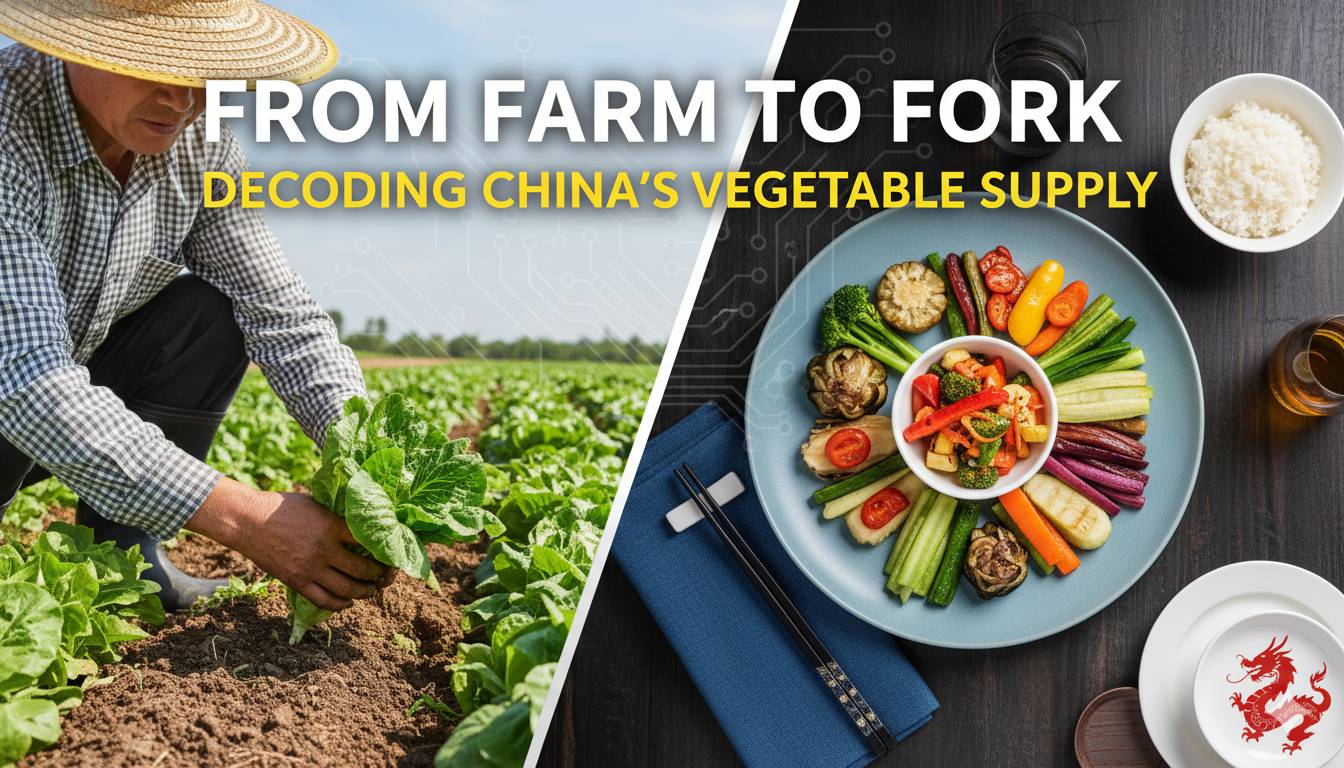
“China’s vegetable supply chain dominates global production with over 619 million tons annually, driving economic stability through advanced farming techniques, robust distribution networks, and policy-driven self-sufficiency, while influencing U.S. import markets for processed goods amid trade fluctuations.”
China’s vegetable sector stands as a cornerstone of global agriculture, producing more than half the world’s supply and fueling both domestic consumption and international trade. With an annual output exceeding 619 million metric tons, the country leads in volume and variety, encompassing staples like cabbage, tomatoes, onions, and cucumbers. This massive scale supports a per capita availability of over 500 kilograms per person yearly, far surpassing global averages. Economic valuations peg the vegetable market at approximately USD 74 billion in recent assessments, with projections indicating growth to over USD 103 billion by 2030, propelled by rising urban demand and technological integration.
Key production regions include Shandong, Hebei, and Henan provinces, where fertile plains and controlled environments enable year-round harvesting. Shandong alone contributes nearly 20% of national output, leveraging greenhouse facilities that cover millions of hectares. These areas benefit from state-subsidized irrigation and mechanization, reducing labor costs and boosting yields by up to 15% annually. In economic terms, this translates to a sector CAGR of around 5.8%, with vegetables accounting for over 55% of the combined fruits and vegetables market revenue.
Supply Chain Breakdown
The journey from farm to consumer involves a multifaceted network of cultivation, logistics, and retail. At the farm level, smallholder operations coexist with large-scale agribusinesses, where hybrid seeds—valued at USD 1.1 billion in the market—enhance resilience against pests and climate variability. Seed advancements, including gene-edited varieties, have increased output by 4.64% compounded annually, focusing on high-yield crops suited for protected cultivation.
Post-harvest, cold chain infrastructure plays a pivotal role, with investments in refrigerated transport minimizing spoilage rates to under 10%. Major hubs like Beijing and Shanghai feature wholesale markets handling billions in transactions daily, where digital platforms streamline auctions and pricing. Retail distribution spans wet markets, supermarkets, and e-commerce giants, ensuring affordability—average wholesale prices for key vegetables hover around USD 0.50 per kilogram, stabilizing amid inflationary pressures.
Trade and Export Dynamics
| Stage | Key Components | Economic Impact |
|---|---|---|
| Cultivation | Greenhouse tech, hybrid seeds | USD 1.1B seed market, 4.64% CAGR |
| Harvesting & Processing | Mechanized picking, minimal processing | Reduces losses by 15%, adds USD 36B wholesale value |
| Logistics | Cold chains, rail/road networks | Supports USD 31.7B in vegetable product exports |
| Retail | E-commerce, urban markets | Drives 5.8% market growth to USD 103B by 2030 |
China’s vegetable exports reached USD 3.23 billion in recent monthly data, with a 16.2% increase driven by demand in Asia and beyond. Prepared vegetable products, including canned and frozen items, form a significant portion, valued at USD 31.5 billion annually. For the U.S. audience, this means substantial imports—over USD 993 million in processed vegetables like preserved onions and mushrooms—impacting domestic prices and supply chains. Trade balances show China exporting USD 31.7 billion while importing USD 94 billion in vegetable products, highlighting a net exporter status in high-value segments.
U.S.-China trade in this sector has seen volatility, with recent agreements stabilizing flows. China’s purchases of related agricultural inputs indirectly support U.S. exporters, though direct vegetable imports remain niche. Global rankings place China as the top exporter, ahead of Spain and Mexico, influencing commodity futures where vegetable-related contracts reflect supply stability.
Challenges in the Pipeline
Despite dominance, the supply chain faces hurdles like weather disruptions and resource constraints. Cold waves in regions like Xinjiang necessitate rapid adjustments, with local governments ramping up greenhouse production to maintain supply. Labor shortages in rural areas push mechanization, while water scarcity in northern provinces prompts efficient irrigation adoption, saving billions in costs.
Policy interventions, such as the longstanding Vegetable Basket Project initiated in 1988, ensure urban access through subsidies and reserves. Recent focuses include informatization rates exceeding 27%, integrating AI for yield prediction and reducing waste across the chain—estimated at 460 billion kilograms annually if unchecked.
Innovations Driving Efficiency
Technological leaps are reshaping the sector. Smart agriculture, including drone monitoring and automated harvesting, boosts productivity in facilities covering over 28 million hectares. Biotech advancements in seeds target climate resilience, with domestic varieties now holding over 80% market share in key crops. E-commerce seed sales and counterfeit-proof models further streamline inputs, fostering a fragmented yet competitive landscape where top players capture modest shares.
Economic ripple effects include job creation—millions employed in processing—and forex earnings from exports to markets like Vietnam and Japan. For U.S. stakeholders, this innovation signals opportunities in tech exports, though tariffs on related goods add layers to bilateral dynamics.
Market Projections and Key Metrics
Forward-looking data anticipates production climbing to 662 million tons by 2028, with exports sustaining growth amid global demand. Wholesale revenues are set to rise at 4.3% CAGR, reaching USD 36.4 billion, buoyed by urban consumption trends favoring diverse, premium varieties.
| Metric | Current (2026) | Projected (2030) |
|---|---|---|
| Production Volume | 619M tons | 662M tons |
| Market Value | USD 74B | USD 103B |
| Export Value | USD 31.7B | USD 40B+ |
| CAGR | 5.8% | Sustained |
These figures underscore the sector’s resilience, with policy emphasis on self-reliance mitigating external shocks. Urbanization drives demand for processed goods, aligning with global trends where China’s output influences commodity benchmarks.
Disclaimer: This news report is for informational purposes only. Tips and sources are not mentioned.