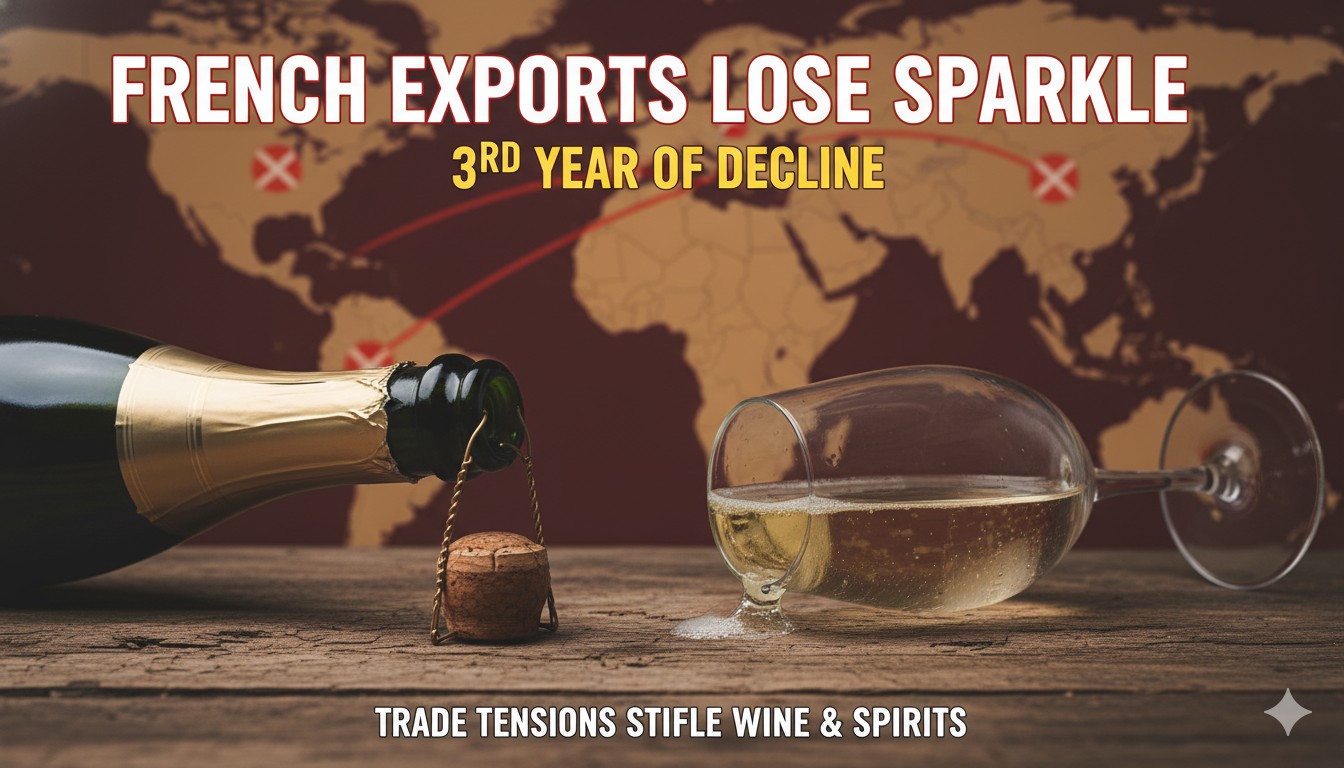
**” French wine and spirits exports declined for the third straight year in 2025, falling 8% in value to €14.3 billion ($17.03 billion) and 3% in volume to 168 million cases, primarily due to heightened U.S. tariffs and ongoing anti-dumping duties in China that have severely impacted demand in two of the sector’s largest markets. “**
French Wine and Spirits Exports Face Prolonged Headwinds from Global Trade Barriers
The French wine and spirits industry, long a cornerstone of the nation’s export economy and cultural heritage, continued its downward trajectory in 2025. Data released by the French Federation of Wine and Spirits Exporters (FEVS) confirmed that total exports dropped 8% in value to €14.3 billion, equivalent to approximately $17.03 billion at current exchange rates, while volumes slipped 3.3% to 168 million cases. This marks the third consecutive year of contraction, with cumulative value declines reaching 17% since 2022. The sector has slipped from France’s second-largest export category to third, now trailing aerospace and cosmetics.
Trade tensions emerged as the dominant factor suppressing performance. In the United States—traditionally the top destination for French wines, Champagne, and spirits—exports plunged 21% in value to around €3.0 billion, with volumes falling below 30 million cases. The decline accelerated sharply in the second half of the year, as tariffs initially set at 10% and later raised to 15% on European alcoholic beverages took full effect. Threats of even steeper levies, including potential hikes up to 200% on select products, further chilled importer confidence and consumer demand, particularly for premium offerings. Late-year data highlighted the severity: shipments of spirits to the U.S. tumbled 47% in the final quarter, while wine exports dropped 39% over the same period.
China presented another major challenge. Exports to the world’s second-largest economy fell 20% to €767 million, driven by anti-dumping duties that disproportionately targeted high-value spirits such as cognac, armagnac, and other wine-based products. These measures have sharply curtailed shipments, compounding structural issues like declining overall wine consumption in the market. While French producers have pursued a premiumization strategy—raising average prices to offset volume losses—the approach has only partially mitigated the damage.
The broader category breakdown reveals uneven pressures. Wine, which constitutes the overwhelming majority of exports, saw a more moderate 4.1% value decline compared to the overall sector figure. Spirits, however, bore a heavier burden from targeted duties in both the U.S. and China, where cognac and related categories have historically been strong performers.
Regional and product-specific impacts further illustrate the challenges. In the U.S., the combination of higher landed costs and a weaker dollar eroded competitiveness, prompting some producers to absorb tariff costs through price reductions that squeezed margins. In Asia beyond China, markets showed mixed results, but insufficient to offset losses in the two largest buyers. European intra-trade remained relatively stable but failed to provide meaningful growth to counterbalance international weakness.
Industry leaders have highlighted a confluence of factors beyond tariffs, including geopolitical uncertainties, exchange rate volatility, and reduced household confidence amid economic pressures in key consuming nations. These elements have collectively dampened demand for discretionary luxury goods like fine wines and premium spirits.
Looking at longer-term positioning, the sector’s reliance on the U.S. and China—accounting for a substantial portion of global sales—has amplified vulnerability to bilateral disputes. Efforts to diversify into emerging markets in Asia, Latin America, and Africa have progressed but remain nascent compared to established channels.
Producers face difficult strategic choices. Some regions have seen discussions around vineyard restructuring, including potential grubbing-up of less profitable vines to rebalance supply with softened demand. Premium segments continue to hold pricing power in select markets, but mid-range and entry-level products have struggled more acutely.
The export downturn has ripple effects across the supply chain. Growers, négociants, bottlers, and logistics providers all feel the strain from reduced orders and inventory buildups. Employment in viticulture and distillation remains under pressure, particularly in spirits-heavy areas like the Cognac region.
Despite the headwinds, the industry retains fundamental strengths: unparalleled appellation quality, brand heritage, and global recognition. Adaptation strategies include intensified marketing in tariff-light markets, innovation in sustainable practices to appeal to evolving consumer preferences, and advocacy for trade resolutions that could restore fair access.
The current environment underscores the fragility of luxury export sectors in an era of rising protectionism. With trade barriers showing no immediate signs of easing and threats of further escalation looming, 2026 remains clouded with uncertainty for French wine and spirits producers.
Disclaimer: This is a news report based on industry data and market developments. It is for informational purposes only and does not constitute financial, investment, or trading advice.