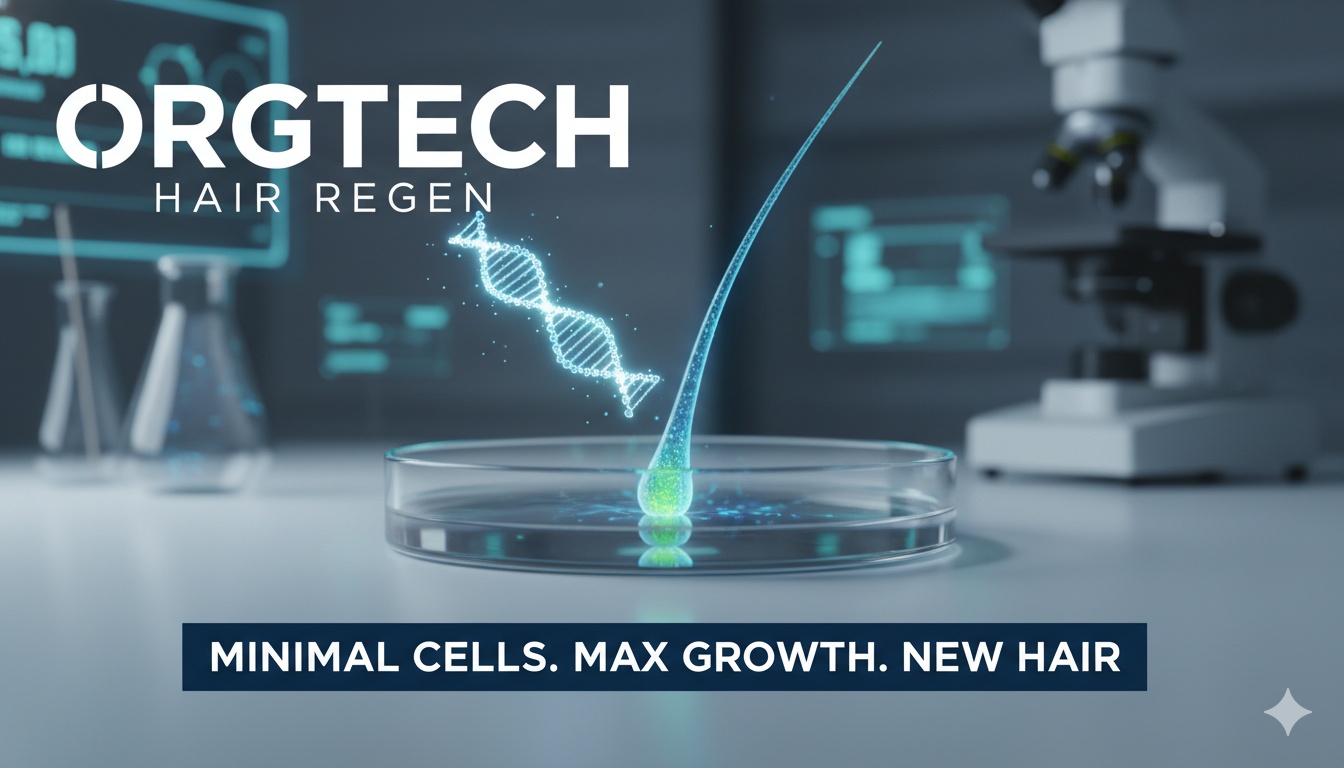
“In a major advancement for regenerative medicine, Japanese biotech firm OrganTech has identified the minimal combination of three adult stem cell types that can fully regenerate functional hair follicles in a controlled laboratory setting. This breakthrough, achieved using murine models, highlights a previously unrecognized supporting mesenchymal cell population essential for complete hair cycle progression, including sustained downgrowth and hair shaft production. The findings strengthen the foundation for future cell-based therapies targeting alopecia and could pave the way for more precise, scalable approaches to hair restoration.”
Breakthrough in Hair Follicle Bioengineering
OrganTech’s latest research marks a pivotal step forward in the quest to regenerate fully functional hair follicles from adult-derived stem cells without relying on complex external factors or undefined components. The study, conducted by a team including key figures from OrganTech and collaborators with deep roots in organ induction research, focused on reconstructing hair follicle organ germs in vitro.
Previously, efforts to regenerate hair follicles in lab conditions often stalled at partial stages, such as initial bulb formation, without achieving the full cyclic behavior seen in natural hair growth. The team addressed this limitation by systematically identifying the cellular requirements for autonomous regeneration. They utilized adult murine hair follicle-derived cells and pinpointed that epithelial stem cells from the bulge region and dermal papilla cells alone were insufficient for complete functionality.
The critical addition proved to be a newly characterized accessory mesenchymal cell population, termed hair follicle regeneration–supporting cells. These cells, isolated from the boundary zone near the epithelial stem cell niche and marked by specific surface expressions like PDGFRα+, Sca1+, and CD34 high+, play an indispensable role in driving the downgrowth phase and enabling sustained hair production.
By combining these three cell types—bulge-derived epithelial stem cells, dermal papilla cells, and the supporting mesenchymal cells—the researchers successfully created three-stem-cell-derived organ germs. When cultured in a defined in vitro system, these reconstructed follicles demonstrated key hallmarks of functionality:
Formation of a structured hair bulb
Progressive downgrowth into the dermal equivalent
Production of hair shafts
Evidence of hair cycle-associated phases, including regression and potential rest periods
This minimal set allows for regeneration under controlled, serum-free or defined conditions, reducing variability and enhancing reproducibility—a crucial factor for eventual clinical translation.
The approach builds on the established organ germ method, which involves dissociating and reaggregating cells to form primordia capable of self-organization. In this iteration, the inclusion of the supporting cells enabled the organ germs to progress beyond early morphogenesis. Experiments showed that omitting the supporting population resulted in arrested development, underscoring their non-redundant contribution to epithelial-mesenchymal crosstalk essential for follicle maturation.
Implications for alopecia treatment loom large. Millions of Americans suffer from androgenetic alopecia, alopecia areata, or other forms of hair loss, where current options like topical minoxidil, oral finasteride, or surgical transplants provide symptomatic relief but fail to address underlying follicular miniaturization or destruction in a regenerative manner. Cell-based therapies using a defined, minimal stem cell cocktail could offer a more targeted solution, potentially using autologous cells to avoid immune rejection risks.
OrganTech’s platform emphasizes epithelial-mesenchymal interactions, a core principle in organ regeneration. The in vitro success with murine cells provides a blueprint that could inform human applications, though species differences in follicle biology will require further validation. The defined cellular framework simplifies scalability, as it minimizes the number of components needed while maximizing functional output.
Key technical aspects of the regeneration process include:
Precise isolation techniques to obtain pure populations of each cell type
Controlled reassembly into organ germs via the organ germ method
In vitro organ culture systems that support long-term growth and cycling without transplantation
The regenerated follicles exhibited robust integration and functionality in the lab environment, producing hair structures with morphological fidelity to natural ones. This level of autonomy in vitro represents a departure from prior models that often depended on in vivo transplantation for full maturation.
Looking ahead, this discovery refines the path toward next-generation regenerative strategies. By establishing a minimal yet complete cellular unit, OrganTech advances the field toward therapies that could one day enable de novo hair follicle creation from a patient’s own cells, potentially revolutionizing treatment for pattern baldness and scarring alopecias.
The research underscores the power of dissecting niche components to unlock regenerative potential, offering hope that functional hair restoration may move from experimental promise to practical reality in the coming years.
Disclaimer: This article is for informational purposes only and does not constitute medical advice, investment recommendation, or endorsement of any product or procedure. Regenerative medicine remains an evolving field with ongoing research required for safety and efficacy in humans.