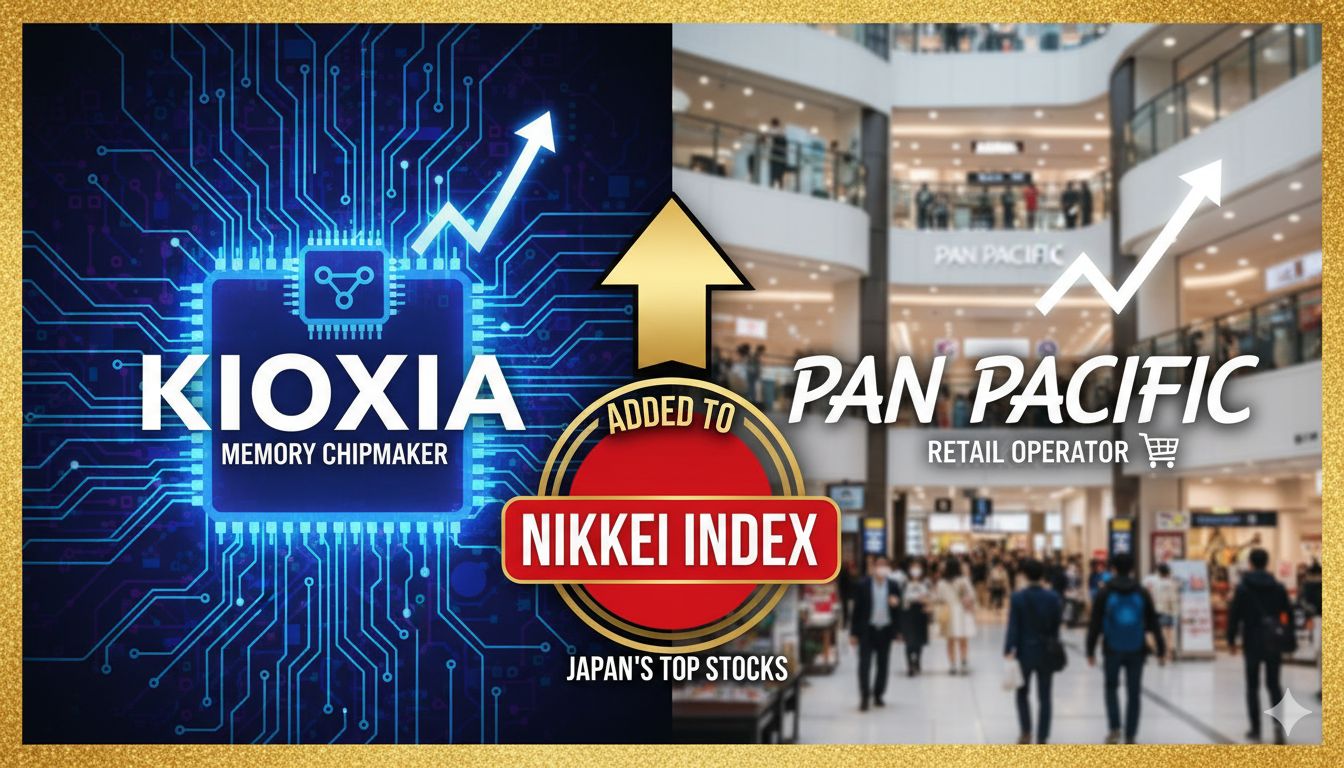
In a significant update to Japan’s premier stock benchmark, memory chip leader Kioxia Holdings and discount retail powerhouse Pan Pacific International Holdings will join the Nikkei 225 starting April 1, 2026. The additions, driven by strong liquidity for Kioxia and sector rebalancing for Pan Pacific, come amid removals of GS Yuasa and Casio Computer, positioning the index to better reflect current market dynamics in technology and consumer sectors amid ongoing AI-driven demand and economic shifts.
Nikkei 225 Adds Tech and Retail Heavyweights in Latest Rebalance
The Nikkei Stock Average, one of Asia’s most watched equity benchmarks, is undergoing its periodic constituent review with notable inclusions that highlight evolving market priorities. Effective April 1, 2026, Kioxia Holdings Corporation (ticker: 285A) and Pan Pacific International Holdings Corporation (ticker: 7532) will enter the 225-component index. These changes replace GS Yuasa Corporation and Casio Computer Co., Ltd. , aligning the gauge more closely with high-liquidity names and improved sector representation.
Kioxia’s entry stems directly from its robust trading liquidity, a key criterion for Nikkei inclusion. As a major player in NAND flash memory, the company has capitalized on surging global demand for data storage solutions fueled by artificial intelligence applications, cloud computing expansion, and enterprise server upgrades. Memory prices have rebounded strongly in recent quarters after a prolonged downturn, providing tailwinds for manufacturers like Kioxia. The firm’s shares have delivered exceptional performance, surging significantly year-to-date on the back of AI-related momentum. This positions Kioxia as a direct beneficiary of the ongoing tech megatrend, where hyperscale data centers require ever-larger volumes of high-performance storage.
Pan Pacific International Holdings brings a different flavor to the index through its consumer-facing retail operations. Best known for owning and operating the wildly popular Don Quijote discount chain—famous for its eclectic mix of everyday goods, snacks, cosmetics, and electronics at bargain prices—the company has built a resilient business model that thrives on high foot traffic and value-driven shopping. Pan Pacific’s addition addresses sector balance within the Nikkei 225, boosting representation in consumer goods and retail amid a broader push to diversify away from over-reliance on certain traditional industries. The retailer’s shares have tracked the broader market’s upward trajectory reasonably well, reflecting steady consumer spending patterns in Japan despite periodic economic headwinds.
These adjustments occur against a backdrop where the Nikkei 225 reached historic peaks earlier in 2026 before facing some pullback pressure from geopolitical tensions in the Middle East and fluctuating global risk sentiment. The benchmark’s momentum has been supported by corporate governance improvements, shareholder-friendly policies, and a weaker yen environment that benefits exporters. Adding high-profile names like Kioxia and Pan Pacific could inject fresh liquidity and attract greater institutional interest, particularly from passive funds and ETFs that track the index.
Index-linked investing plays a major role here. Inclusion in the Nikkei 225 typically triggers buying from index funds, ETFs, and pension portfolios that must rebalance holdings to match the new composition. This often leads to short-term upward pressure on the incoming stocks’ prices as managers adjust positions ahead of the effective date. Conversely, the removed companies—GS Yuasa in batteries and Casio in electronics—may see selling pressure as funds divest to maintain alignment.
For Kioxia , the spotlight intensifies on its position in the memory ecosystem. The company supplies NAND solutions to major clients across smartphones, PCs, data centers, and automotive applications. With AI workloads demanding massive storage capacity for training large language models and inference tasks, demand for advanced flash memory remains elevated. Kioxia’s technological edge in 3D NAND architecture and its partnerships in the industry underscore its relevance in a world increasingly powered by data.
Pan Pacific International Holdings adds a consumer resilience angle. Don Quijote stores operate nearly around the clock in urban locations across Japan, drawing both locals and tourists with their treasure-hunt shopping experience. The company’s expansion strategy, including international forays and format diversification, has helped sustain growth even as broader retail faces competition from e-commerce giants. Its inclusion enhances the index’s exposure to domestic consumption trends, which remain a critical driver of Japan’s economy.
The rebalance also reflects broader efforts to modernize the Nikkei 225. Recent years have seen similar moves to incorporate faster-growing sectors while phasing out underperformers or lower-liquidity names. With technology and consumer discretionary areas gaining prominence globally, these changes ensure the index remains representative of Japan’s leading economic forces.
Investors will closely monitor trading volumes and price action in the lead-up to April as arbitrage and rebalancing flows build. Kioxia’s liquidity-driven selection suggests strong market interest already exists, while Pan Pacific’s sector-adjustment rationale points to a deliberate effort to broaden the benchmark’s appeal.
Changes to Nikkei 225 Constituents (Effective April 1, 2026)
Added :
Kioxia Holdings Corporation (Technology/Semiconductors – High liquidity)
Pan Pacific International Holdings Corporation (Consumer Goods/Retail – Sector balance)
Removed :
GS Yuasa Corporation
Casio Computer Co., Ltd.
This reshuffle underscores the dynamic nature of Japan’s equity market, where innovation in AI-enabling technologies and adaptable retail models are earning greater prominence on the benchmark stage.
Disclaimer: This is general market commentary based on publicly available information and should not be construed as investment advice, financial recommendation, or solicitation to buy or sell securities. Investors should conduct their own due diligence and consult qualified professionals before making decisions.