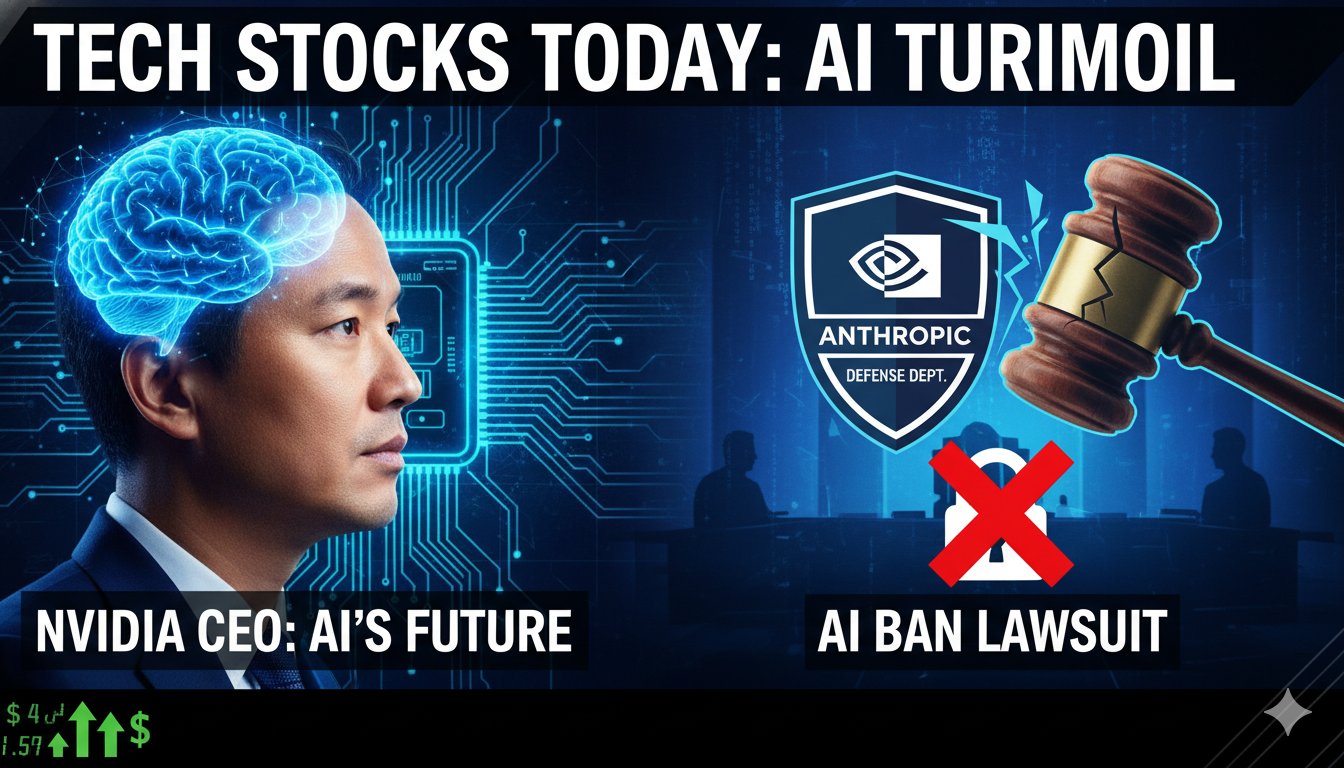
“In a pivotal day for the AI sector, Nvidia’s CEO Jensen Huang published a rare blog post framing AI as the largest infrastructure buildout in human history, structured as a ‘five-layer cake’ from energy to applications, while emphasizing job creation over destruction. Meanwhile, AI startup Anthropic escalated its clash with the U.S. government by filing lawsuits against the Department of Defense and related agencies over a ‘supply chain risk’ designation and ban on its technology, stemming from restrictions on military uses like autonomous weapons. Tech stocks showed mixed performance amid these developments, with Nvidia holding steady near recent levels.”
Tech Stocks in Focus Amid AI Infrastructure Vision and Government Clash
The technology sector continues to revolve around the explosive growth of artificial intelligence, with major headlines today underscoring both the immense opportunities and emerging tensions in the space.
Nvidia CEO Jensen Huang, in one of his infrequent standalone blog posts, outlined a comprehensive vision of AI’s transformative role. He described AI not as a fleeting application or isolated model but as essential infrastructure comparable to historical shifts like electrification. Huang presented AI development as a “five-layer cake”:
Energy — The foundational layer, requiring massive new power generation to support hyperscale computing demands.
Chips — Advanced semiconductors, where Nvidia dominates with its GPUs powering training and inference.
Physical infrastructure — Data centers and related facilities to house the computing scale.
Models — The AI systems themselves, from foundational large language models to specialized variants.
Applications — The end-user tools and software that deliver value across industries.
Huang argued that this multi-trillion-dollar buildout—already seeing hundreds of billions invested—remains in its early stages, with trillions more needed in energy, computing, and beyond. He pushed back against fears of widespread job losses, asserting that AI will mirror past industrial revolutions by creating vast numbers of skilled, well-paid roles in construction, engineering, maintenance, and related fields—such as electricians, plumbers, and steelworkers—while augmenting human productivity rather than replacing it entirely. This perspective comes as Nvidia prepares for its upcoming GTC conference, where further advancements in the AI stack are expected to be showcased.
Huang’s comments reinforce Nvidia’s position at the center of the AI boom. The company’s hardware underpins the training of leading models, and demand shows no signs of abating. As of mid-session trading today, Nvidia (NVDA) shares are trading around $185.40, up modestly by about 0.33% from the previous close of $184.77. The stock has fluctuated within a day’s range of approximately $184.84 to $187.62, reflecting steady investor interest despite broader market caution. Nvidia’s market capitalization hovers near $4.5 trillion, underscoring its dominance in semiconductors and AI accelerators.
In a contrasting development highlighting risks in the AI ecosystem, Anthropic has taken legal action against the U.S. Department of Defense and associated federal entities. The company filed two lawsuits challenging the Pentagon’s recent designation of Anthropic as a “supply chain risk to national security.” This label, typically applied to foreign adversaries, effectively blacklists the firm from defense-related contracts and prohibits military contractors from using its Claude AI models.
The dispute originated from Anthropic’s refusal to remove built-in safeguards on its technology. The company maintains strict policies prohibiting the use of Claude for fully autonomous lethal weapons or mass domestic surveillance of U.S. citizens. After negotiations failed, the Defense Department escalated by imposing the risk designation, and broader federal restrictions followed, including directives to cease using Anthropic products across government agencies.
Anthropic argues that the actions constitute unlawful retaliation against its protected viewpoints on AI safety and ethics, violating constitutional rights and statutory procedures. The lawsuits seek to overturn the designation, halt enforcement, and prevent irreparable economic harm to the company, which has built significant value as one of the fastest-growing private AI firms.
This standoff raises questions about the intersection of AI governance, national security, and private-sector innovation. While some view Anthropic’s guardrails as prudent, others see them as limiting U.S. defense capabilities in an era of accelerating global competition in AI. The outcome could influence how other frontier AI developers balance commercial interests, ethical commitments, and government partnerships.
Broader tech stock performance reflects these mixed signals. The Nasdaq Composite has experienced slight downward pressure today, trading down around 0.28% in recent activity, with the Nasdaq-100 showing a similar modest decline of about 0.29%. Key players like Apple, Microsoft, and Broadcom have seen varied movements, but the sector remains sensitive to AI-related narratives.
| Stock | Current Price (approx.) | Daily Change | Market Cap (approx.) | Notes |
|---|---|---|---|---|
| NVDA (Nvidia) | $185.40 | +0.33% | $4.5T | Holding firm on Huang’s bullish AI outlook |
| AAPL (Apple) | $260.45 | -0.15% | $3.8T | Steady amid broader tech sentiment |
| MSFT (Microsoft) | $403.00 | -0.68% | $3.0T | AI integrations continue to drive long-term bets |
| AVGO (Broadcom) | $341.18 | -0.41% | $1.6T | Benefiting from AI chip demand |
These developments illustrate the dual nature of the current AI-driven market: enormous growth potential tied to infrastructure expansion, tempered by regulatory, ethical, and geopolitical hurdles. Investors will likely monitor Nvidia’s forthcoming events for more catalysts, while watching the Anthropic case for precedents in AI policy and defense contracting.
Disclaimer: This is for informational purposes only and does not constitute financial advice, investment recommendation, or solicitation to buy or sell securities. Market data is subject to rapid change; always conduct your own research.