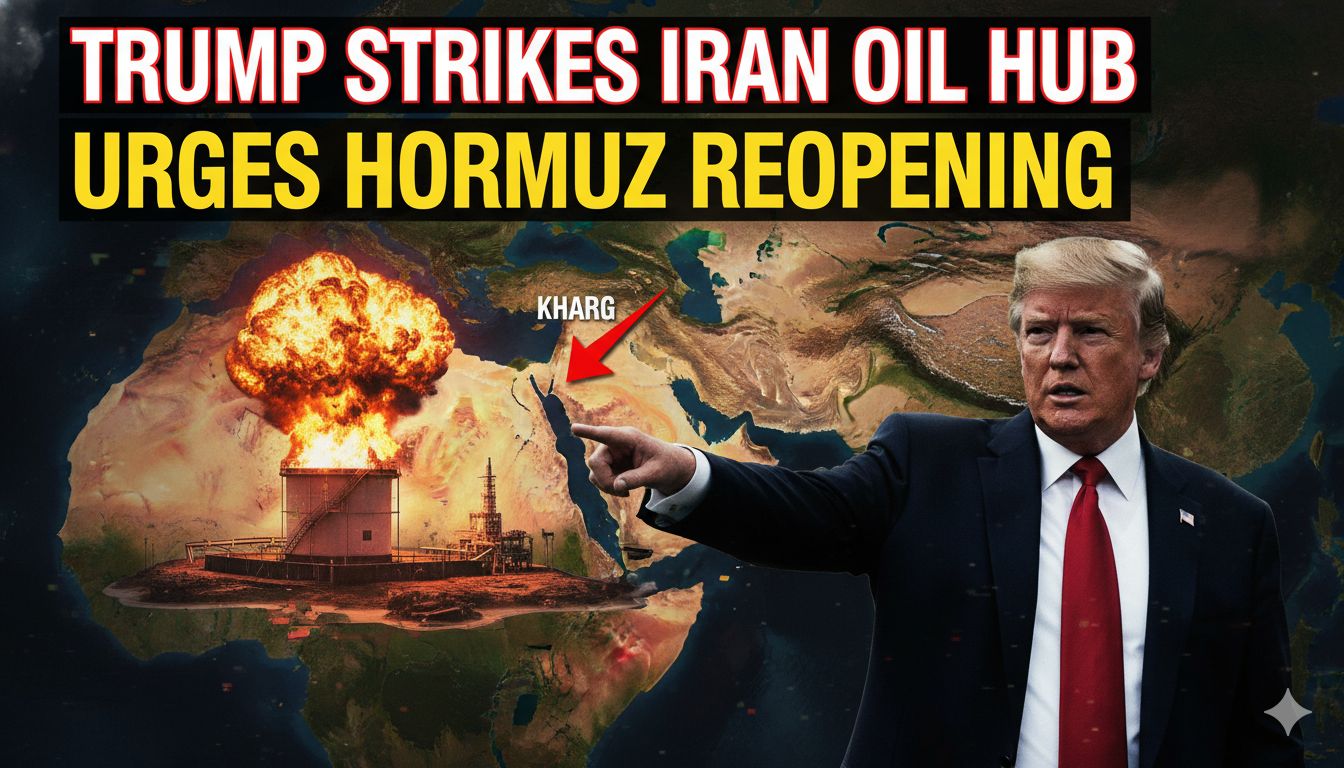
In a significant escalation of the ongoing U.S.-Iran conflict, President Donald Trump announced that U.S. forces conducted precision strikes on military targets at Iran’s Kharg Island, the critical hub handling approximately 90% of the nation’s oil exports. The operation deliberately spared oil infrastructure, but Trump issued a stern warning: any further Iranian interference with shipping through the Strait of Hormuz would prompt reconsideration of that restraint. The strikes, described as one of the most powerful bombing raids in Middle East history, targeted over 90 military sites including missile bunkers and naval facilities, amid Iran’s efforts to disrupt maritime traffic in the vital strait. This move aims to pressure Tehran to restore safe passage while avoiding immediate global energy catastrophe.
U.S. Precision Strikes Target Military Assets on Kharg Island
President Donald Trump confirmed late Friday that U.S. Central Command executed a large-scale precision bombing raid on Kharg Island, a small but strategically vital landmass in the Persian Gulf. The island serves as Iran’s primary oil export terminal, processing and loading the vast majority of its crude shipments destined primarily for Asian markets, particularly China.
Trump described the operation in stark terms, stating that U.S. forces “totally obliterated every MILITARY target” on the island. Footage shared by the president showed dramatic explosions lighting up the night, highlighting the use of advanced stealth aircraft, including B-2 bombers, in the strikes. U.S. officials emphasized that the targets included naval mine storage facilities, missile bunkers, and other defensive installations, with more than 90 sites confirmed destroyed.
Crucially, the oil infrastructure—terminals, pipelines, storage tanks, and loading jetties—remained untouched. Trump explained this decision as one rooted in “reasons of decency,” signaling a calibrated approach that demonstrates U.S. military superiority without immediately triggering a full-scale energy crisis. He posted on social media: “I have chosen NOT to wipe out the Oil Infrastructure on the Island. However, should Iran, or anyone else, do anything to interfere with the Free and Safe Passage of Ships through the Strait of Hormuz, I will immediately reconsider this decision.”
This restraint comes against the backdrop of Iran’s aggressive actions in the Strait of Hormuz, the narrow chokepoint through which roughly 20% of global oil supply flows daily. Tehran has laid naval mines, attacked vessels, and effectively halted most commercial traffic for days, leading to what analysts describe as one of the largest oil supply disruptions in modern history. Reports indicate over a dozen ships have faced incidents in the region since the conflict intensified, with mining efforts and direct harassment forcing rerouting or halts.
Iranian officials have downplayed the impact of the Kharg strikes, claiming no damage to oil facilities and no casualties from the raid. State media maintained that exports continue normally, though independent verification remains challenging amid the fog of war. Tehran has responded defiantly, with the Islamic Revolutionary Guard Corps (IRGC) warning that any future hits on energy assets would result in retaliation against U.S.-linked oil infrastructure across the Gulf, potentially targeting facilities in allied nations like the UAE and Saudi Arabia.
The strategic calculus behind sparing Kharg’s oil operations is clear: destroying the terminal could remove 1.3 to 1.6 million barrels per day from global markets—potentially more if Iran had ramped up volumes in anticipation of conflict. Such a move would send oil prices soaring far beyond current elevated levels, exacerbating inflation and economic strain worldwide. By hitting military assets instead, the U.S. delivers a severe blow to Iran’s defensive capabilities around its economic lifeline while preserving leverage for de-escalation.
Kharg Island’s importance cannot be overstated. Roughly 5 miles long, this isolated outpost handles the overwhelming share of Iran’s crude exports, with storage capacity for millions of barrels as a buffer. Its proximity to the Strait of Hormuz amplifies its vulnerability—and its value as a pressure point. The island’s dual role as both military outpost and export gateway makes it a high-stakes target in any prolonged confrontation.
Trump’s accompanying call for the reopening of the Strait of Hormuz underscores Washington’s priority: restoring freedom of navigation. Administration officials have signaled plans for U.S. Navy escorts of tankers, potentially in coordination with international partners, to counter Iranian threats. Defense leaders have dismissed Tehran’s blockade as an act of “desperation,” vowing that the strait will not remain contested.
Market reactions have been swift and volatile. Oil prices, already surging due to the strait disruptions, face renewed uncertainty. While the sparing of oil facilities provides some relief, the implicit threat of future strikes keeps traders on edge. Global energy agencies warn of cascading effects, from higher shipping insurance premiums to supply chain delays impacting everything from fuel to humanitarian aid.
Iran’s economy, heavily reliant on oil revenues, faces mounting pressure. Exports had shown resilience earlier in the conflict, but sustained military degradation around Kharg could limit operational capacity even without direct hits on terminals. Tehran has vowed massive retaliation if pushed further, raising the specter of broader regional attacks on energy assets.
The strikes represent a pivotal moment in the now three-week-old conflict. By targeting Kharg’s military side while holding the oil card in reserve, the U.S. seeks to force Tehran into backing down on Hormuz without crossing the threshold into outright economic warfare. Whether this calibrated escalation compels reopening of the strait or provokes further Iranian defiance remains the central question hanging over global energy markets.
Disclaimer: This is a news report based on publicly available information and official statements. It does not constitute financial advice, investment recommendation, or endorsement of any position. Readers should conduct their own research and consult professionals for decisions related to markets or geopolitics.