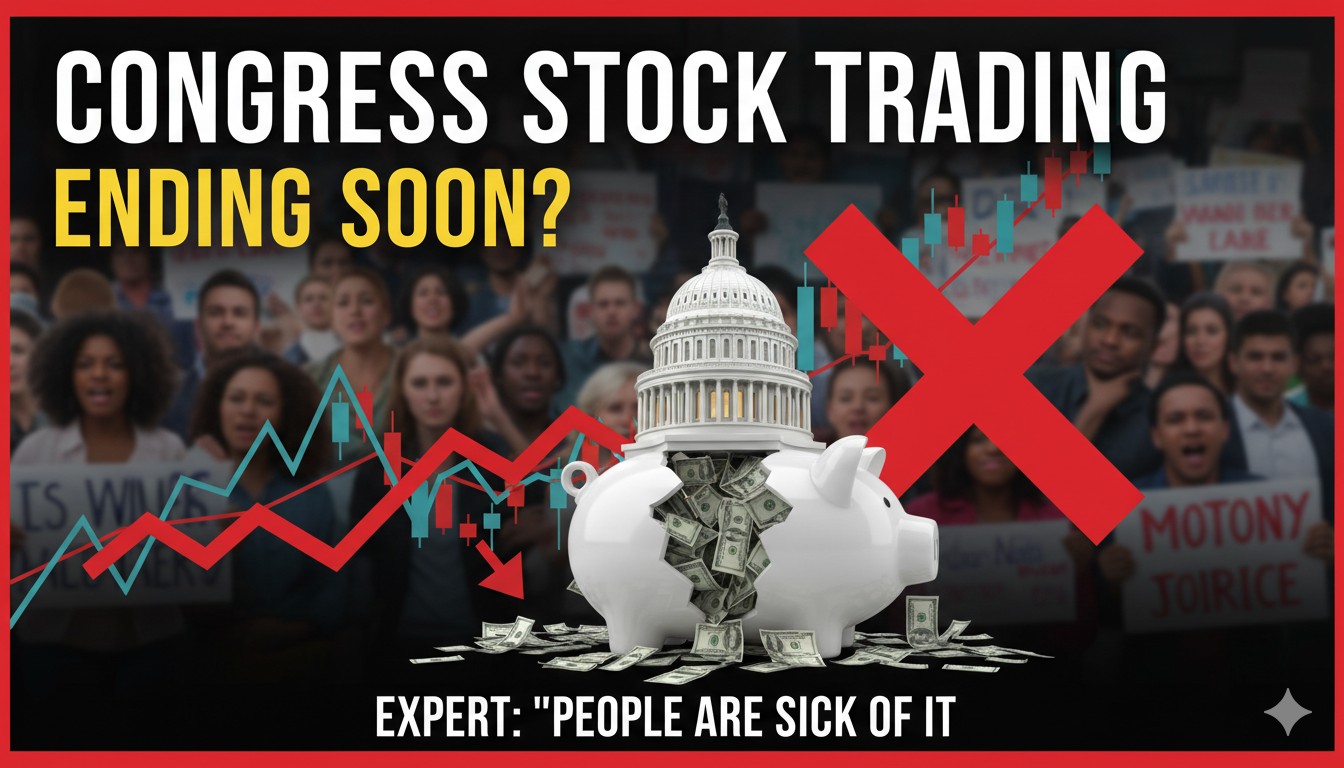
Public sentiment has reached a tipping point, with experts noting widespread disgust over perceived conflicts of interest, especially as platforms track and even replicate congressional trades profitably.
Title: EXCLUSIVE: Congress Stock Trading Could Be Ending Soon – Expert Says ‘People Are Sick Of It’
Synopsis “Momentum is building for a ban on congressional stock trading as bipartisan bills advance in 2026, driven by public outrage over perceived insider advantages and consistent underperformance relative to ethical standards. Experts highlight that widespread frustration—’people are sick of it’—combined with recent legislative pushes could finally close this loophole, though challenges like loopholes in proposals and partisan divides persist.”
Congress Stock Trading Ban Gains Traction Amid Rising Public Anger
The push to prohibit members of Congress from trading individual stocks has intensified in recent months, with new legislation introduced and committee advancements signaling that change may be imminent. This comes against a backdrop of persistent public distrust, where lawmakers’ investment activities often appear to benefit from non-public information gleaned through their positions.
In March 2026, a group of House Democrats, led by Rep. Haley Stevens of Michigan alongside Reps. Derek Tran, Eric Sorensen, and Andrea Salinas, introduced the No Getting Rich in Congress Act. This sweeping proposal would prohibit the President, Vice President, members of Congress, federal candidates, their spouses, and dependent children from buying or selling individual stocks, futures, commodities, or cryptocurrency. It includes strict reporting requirements, enforcement mechanisms, and penalties for violations, aiming to eliminate exemptions and close loopholes that have undermined prior reforms.
This bill builds on earlier efforts in the 119th Congress. In January 2026, House Administration Committee Chairman Bryan Steil (R-WI) introduced the Stop Insider Trading Act, which prohibits members, spouses, and dependent children from purchasing publicly traded stocks while requiring a seven-day public notice before any sales of existing holdings. The measure advanced through the committee on a party-line vote, despite Democratic objections that it fails to mandate full divestment or extend to the executive branch and judiciary. Critics argue it maintains the status quo by allowing lawmakers to retain and sell pre-existing positions with minimal restrictions.
Bipartisan momentum has also appeared in the Senate, where proposals like the Restore Trust in Congress Act call for lawmakers to divest holdings within set periods—180 days for current members and 90 days for new ones—while prohibiting future trades. These efforts reflect growing agreement across party lines that the current disclosure-based system under the 2012 STOCK Act is insufficient, as periodic transaction reports often reveal trades that coincide suspiciously with legislative or regulatory developments.
Public fatigue with the practice has reached critical levels. An expert in the space, who tracks congressional disclosures closely through investment platforms, emphasized that ordinary Americans are increasingly fed up with the optics of elected officials potentially profiting from their access to privileged information. The sentiment that “people are sick of it” captures a broader erosion of trust, where congressional trading is seen not as savvy investing but as an ethical breach that undermines faith in government impartiality.
Data from 2025 underscores the disparity. While the S&P 500 returned approximately 16.8%, congressional portfolios showed mixed results. Aggregate figures indicate Republican-linked trades averaged 17.3% returns and Democratic ones 14.4%, but individual performances varied widely. Top outperformers included members with concentrated bets in sectors like industrials, utilities, and technology, achieving gains of 70% or more in some cases. Over 100 members made thousands of trades totaling hundreds of millions in value, with popular holdings in major tech names like Nvidia, Amazon, and Microsoft. Platforms replicating certain high-profile congressional trades have attracted significant investor interest, further highlighting the perceived edge some lawmakers hold.
| Key 2025 Congressional Trading Highlights |
|---|
| Metric |
| Total Trades (approx.) |
| Total Value Traded |
| S&P 500 Return |
| Avg. Republican Portfolio |
| Avg. Democrat Portfolio |
| Top Individual Returns |
| Active Traders |
Despite these figures, only about 32% of disclosed congressional portfolios outperformed the broader market in 2025, suggesting that while some benefit substantially, many do not. However, the appearance of advantage—particularly when trades align with committee work or briefings—fuels calls for outright prohibition rather than enhanced disclosure.
Advocates argue that banning individual stock ownership would force lawmakers into diversified index funds or blind trusts, eliminating conflicts without restricting public service. Opponents of weaker proposals contend that partial measures, like notice requirements for sales, do little to prevent misuse of information and may even encourage secretive behavior.
As bills continue to circulate and public pressure mounts, the window for meaningful reform appears narrower than in past cycles. With bipartisan cosponsors on several measures and renewed focus following high-profile disclosures, stakeholders suggest that 2026 could mark the turning point where congressional stock trading finally faces meaningful restrictions.
Disclaimer: This is for informational purposes only and does not constitute financial, legal, or investment advice.