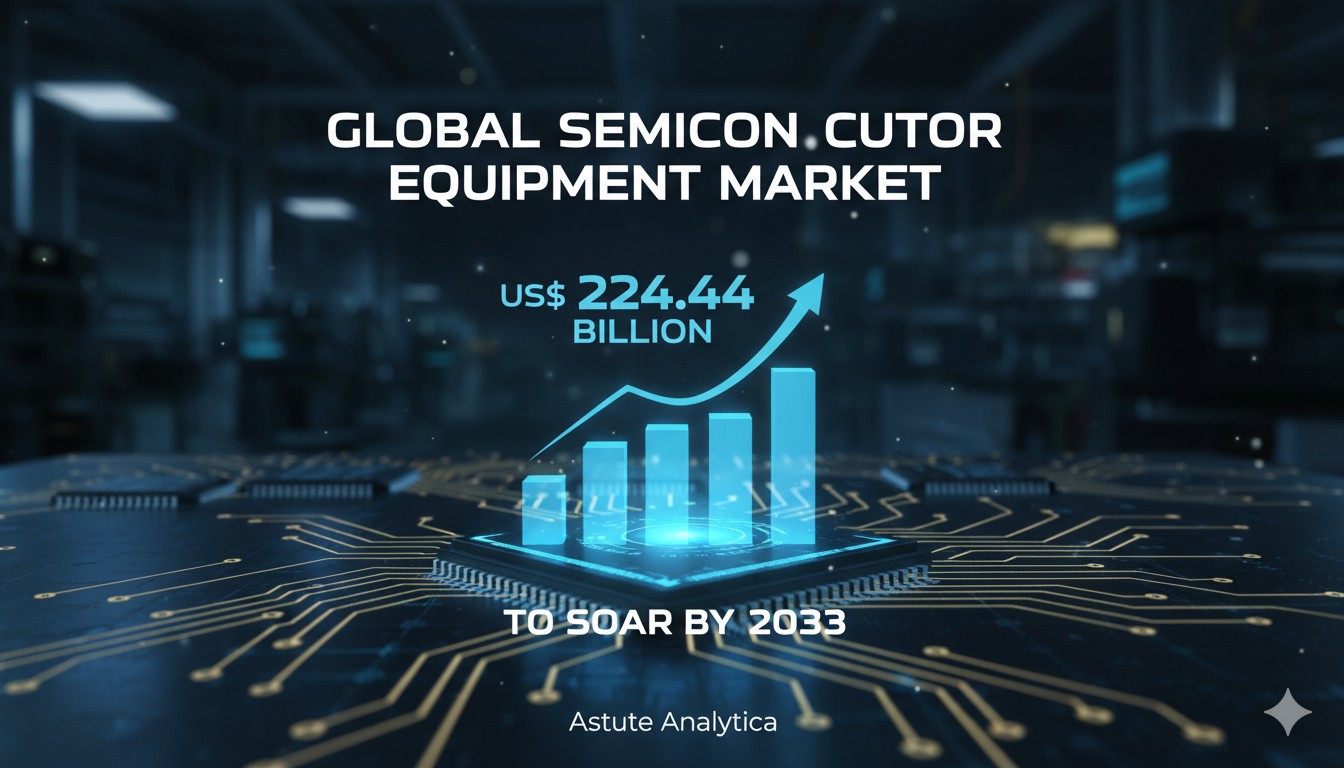
“The global semiconductor manufacturing equipment market, valued at $93.03 billion in 2024, is forecasted to reach $224.44 billion by 2033, driven by surging demand in AI, high-performance computing, and electric vehicles, with a robust CAGR of 10.28% from 2025 to 2033. Key segments include front-end equipment dominating at 74.5% market share, while Asia Pacific leads regionally amid geopolitical shifts and massive fab investments.”
The semiconductor manufacturing equipment sector is experiencing unprecedented growth fueled by technological advancements and strategic investments worldwide. As chipmakers ramp up production for next-generation applications, the market is witnessing a surge in capital expenditures, particularly in artificial intelligence and advanced packaging solutions.
Market Segmentation and Projections
The market breaks down into several key categories, each contributing to the overall expansion:
By Equipment Type :
Front-end equipment accounts for the lion’s share, representing 74.5% of total revenue, encompassing critical processes like lithography, etching, and deposition.
Backend equipment, including testing and assembly tools, is gaining traction with the rise of complex chip designs.
By Region :
Asia Pacific remains the powerhouse, driven by manufacturing hubs in China, Taiwan, South Korea, Japan, and Singapore, where fab expansions are accelerating.
North America, led by the U.S., is seeing renewed momentum through domestic initiatives aimed at bolstering supply chain resilience.
Europe, particularly Western nations like Germany and France, is investing in specialized facilities, while emerging markets in the Middle East, Africa, and South America show promising growth potential.
| Segment | 2024 Market Share (%) | Projected 2033 Value (USD Billion) | CAGR (2025-2033) |
|---|---|---|---|
| Front-End Equipment | 74.5 | ~167 | 10.5% |
| Backend Equipment | 25.5 | ~57 | 9.8% |
| Asia Pacific | 65 | ~146 | 11.2% |
| North America | 20 | ~45 | 9.5% |
| Europe | 10 | ~22 | 8.7% |
| Rest of World | 5 | ~11 | 10.0% |
These projections highlight the front-end dominance and Asia’s lead, with overall market growth outpacing historical averages due to demand for sub-5nm nodes.
Driving Forces Behind the Boom
Several factors are propelling this market forward:
Explosive investments in AI and high-performance computing, with foundries and memory sectors allocating billions to expand capacity.
Transition to electric vehicles and renewable energy grids, necessitating equipment for wide-bandgap materials like silicon carbide and gallium nitride.
Adoption of chiplet architectures and 3D stacking, requiring advanced metrology and bonding tools to ensure precision at nanoscale levels.
Boom in high-bandwidth memory production, where suppliers are tripling output to meet data center needs, straining supply for specialized backend machinery.
Proliferation of new fabrication plants, with dozens under construction globally, each demanding multi-billion-dollar equipment outlays.
Policy support from major economies, including subsidies and incentives to localize production and reduce dependencies on foreign suppliers.
Amid these drivers, the industry faces headwinds from supply chain bifurcations and concentrated demand in high-end segments, potentially slowing diversification efforts.
Opportunities and Emerging Trends
The landscape offers substantial opportunities for innovation:
Specialized tools for emerging technologies, such as hybrid bonding systems and AI-integrated predictive maintenance in fully automated fabs.
Regional shifts toward self-sufficiency, creating pipelines for equipment orders in new geographies.
Integration of photonics and laser systems to enhance manufacturing efficiency for advanced electronics.
Recent trends underscore AI’s role in reshaping demand, with equipment sales for accelerators expected to grow significantly. Geopolitical strategies are also influencing trade flows, prompting diversified sourcing and investments in domestic capabilities.
Key Players Shaping the Industry
A handful of giants dominate the competitive arena, leveraging R&D and strategic moves to capture market share:
Tokyo Electron Limited
Lam Research Corporation
ASML Holdings N.V.
KLA-Tencor Corporation
Applied Materials Inc.
Screen Holdings Co., Ltd.
Teradyne Inc.
Hitachi High-Technologies Corporation
Advantest Corporation
Other notable entities include Plasma-Therm, Rudolph Technologies, and a vibrant startup ecosystem pushing boundaries in niche tools.
These companies are actively pursuing expansions, such as new facilities in key regions and acquisitions to broaden portfolios in vacuum systems, materials, and abatement technologies.
Disclaimer: This news report is for informational purposes only and should not be considered as investment advice or tips. All information is derived from publicly available sources.