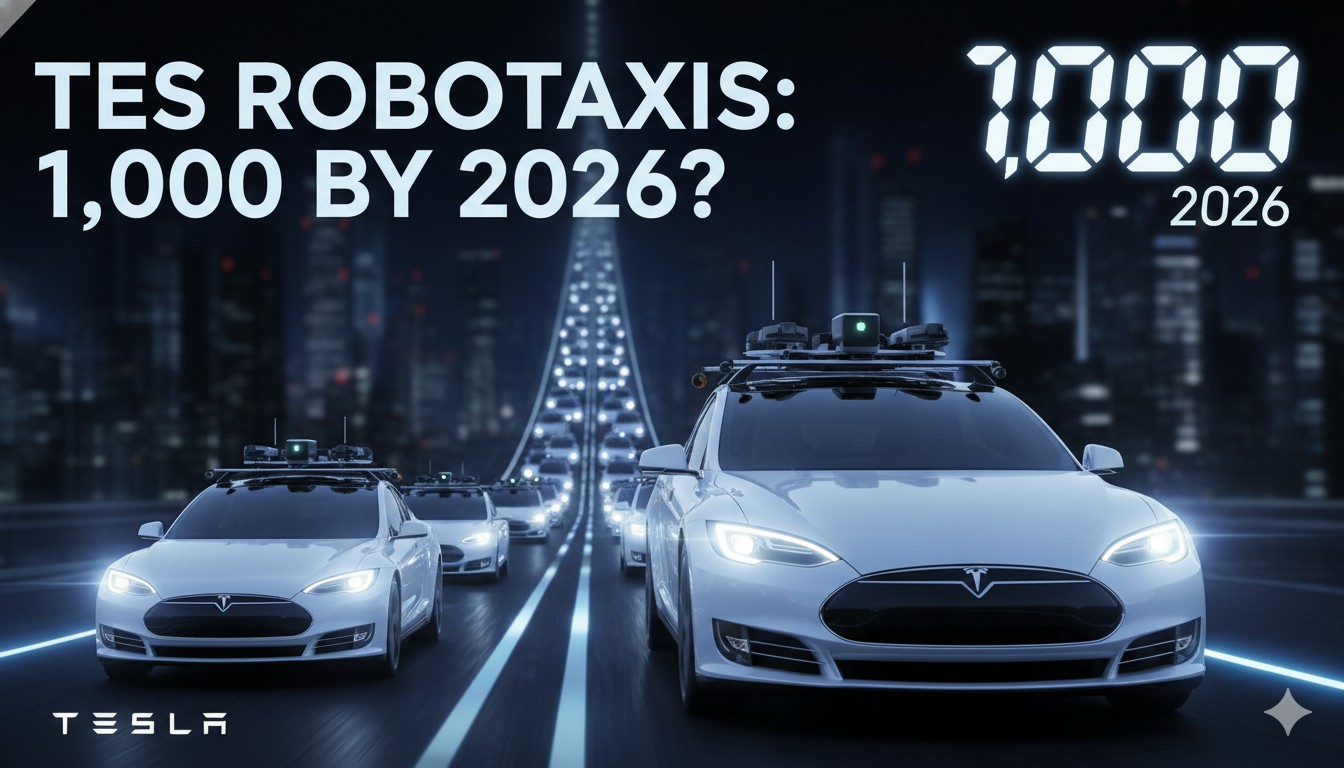
“Tesla’s ambitious robotaxi expansion hinges on Cybercab production ramping up from April, unsupervised rides already underway in Austin, and potential fleet growth to 1,000 vehicles amid regulatory and technological hurdles, potentially transforming the company’s revenue model through high-margin autonomous services.”
Tesla’s push into autonomous ride-hailing has accelerated with the recent launch of unsupervised robotaxi operations in Austin, marking a shift from supervised testing to real-world deployment without safety drivers. This development positions the company to scale its fleet significantly over the coming months, leveraging its Full Self-Driving (FSD) software stack. Analysts project that by year-end, the fleet could reach around 1,000 vehicles, driven by the introduction of the purpose-built Cybercab and expansion into multiple U.S. cities. The strategy relies on vision-only autonomy, which uses cameras and AI to navigate without additional sensors like lidar, potentially lowering costs and enabling faster rollout compared to competitors relying on more hardware-intensive systems.
Current operations center on a limited fleet of Model Y vehicles in Austin, where rides are available to select users via a dedicated app. These vehicles operate without human intervention, though remote monitoring ensures safety. Expansion plans include rolling out services to 8-10 major metro areas, such as Las Vegas, Miami, Houston, and Dallas, with international markets under consideration pending approvals. The Cybercab, a two-seater autonomous vehicle without steering wheels or pedals, is set for production starting in April at Tesla’s Texas facility. Initial output will be modest, but the unboxed manufacturing process—assembling modules in parallel rather than sequentially—aims to reduce costs by up to 50% and boost efficiency.
Fleet scaling projections vary, but conservative estimates suggest a buildup from the current handful of vehicles to several hundred by mid-year, reaching the 1,000 mark as production ramps. This growth would be supported by ongoing software updates to FSD, which has already expanded to supervised use in Europe and is eyeing approvals in China. Safety metrics show disengagement rates dropping below one per million miles in testing, outperforming human drivers in certain scenarios. If these trends hold, regulatory bodies in states like Texas, Arizona, and Nevada could greenlight broader operations, allowing Tesla to capture early market share in the $10 trillion global mobility sector.
Regulatory and Operational Challenges
Achieving 1,000 robotaxis requires navigating a patchwork of state regulations. In Texas, where Austin serves as the testing ground, permissive laws have facilitated quick deployment, but scaling to California involves stricter oversight from the Department of Motor Vehicles. Federal guidelines from the National Highway Traffic Safety Administration emphasize data transparency on crashes and interventions, which Tesla addresses through over-the-air updates that refine AI models in real time. Potential roadblocks include insurance liabilities for autonomous vehicles and public acceptance, with surveys indicating 60% of Americans remain wary of driverless rides.
Operationally, Tesla’s network would operate on a revenue-sharing model, where vehicle owners could opt in to earn from rides when not in use, potentially generating $30,000 annually per car at full utilization. Fleet management involves charging infrastructure, with Tesla’s Supercharger network providing an edge—over 50,000 stalls nationwide capable of handling increased demand. Maintenance costs are projected at $0.10 per mile, far below the $0.50 for traditional taxis, thanks to electric powertrains and simplified designs.
Financial Implications for Tesla
| Key Operational Metrics | Current (Q1 2026) | Projected End-2026 |
|---|---|---|
| Fleet Size | ~50 vehicles | 1,000 vehicles |
| Daily Rides Served | 500 | 100,000+ |
| Average Ride Revenue | $15 | $20 |
| Utilization Rate | 40% | 70% |
| Disengagement Rate | 1 per 500k miles | 1 per 2M miles |
The robotaxi initiative could shift Tesla’s revenue mix, with services potentially accounting for 60% of earnings by decade’s end. At 1,000 vehicles, assuming 70% utilization and $1 per mile pricing, annual revenue could approach $1 billion, with margins exceeding 60% due to low variable costs. This contrasts with vehicle sales, where margins hover around 20%. Investors value this pivot highly, pricing in a transformation from automaker to AI-driven mobility provider.
Capital expenditures for Cybercab production are estimated at $10 billion, funded through existing cash reserves of over $30 billion. Economies of scale from battery production at the Nevada Gigafactory and software licensing to other manufacturers could further bolster finances. Competitors like Waymo, with a fleet of 700 vehicles, charge higher rates but face slower scaling due to sensor costs; Tesla’s approach could undercut them by 30-40% on fares.
Competitive Landscape and Market Potential
In the U.S., the ride-hailing market generates $150 billion annually, with autonomous vehicles poised to capture 80% by 2030. Tesla’s first-mover advantage in unsupervised rides gives it a lead over Uber’s partnerships and GM’s Cruise, which has faced setbacks from incidents. Expansion strategies include partnering with municipalities for dedicated lanes and integrating with public transit apps for seamless multimodal travel.
Market penetration could accelerate if FSD approvals extend to Europe by mid-year, adding millions of potential users. Domestically, focus on sunbelt states with favorable weather minimizes edge cases like snow, allowing refinement before colder climates. User data from millions of FSD-equipped personal vehicles feeds the AI, creating a virtuous cycle of improvement.
Technological Roadmap
FSD version 13, currently in beta, incorporates end-to-end neural networks for decision-making, outperforming rule-based systems in complex urban environments. Hardware 5 upgrades in new vehicles enhance compute power, enabling real-time processing of 36 trillion operations per second. Future iterations aim for Level 4 autonomy, where vehicles handle all driving in defined areas without human input.
To reach 1,000 units, Tesla must produce 200-300 Cybercabs monthly post-ramp, supplemented by retrofitted Model Ys. Energy efficiency at 250 watt-hours per mile ensures longer ranges, reducing downtime. Security features, including cabin cameras and geofencing, address vandalism risks in fleet operations.
Disclaimer: This article is for informational purposes only and does not constitute financial advice, investment recommendations, or endorsements. All data and projections are based on publicly available information and should not be relied upon for making decisions. Readers are encouraged to conduct their own research and consult professionals before acting on any news, reports, or tips presented herein.