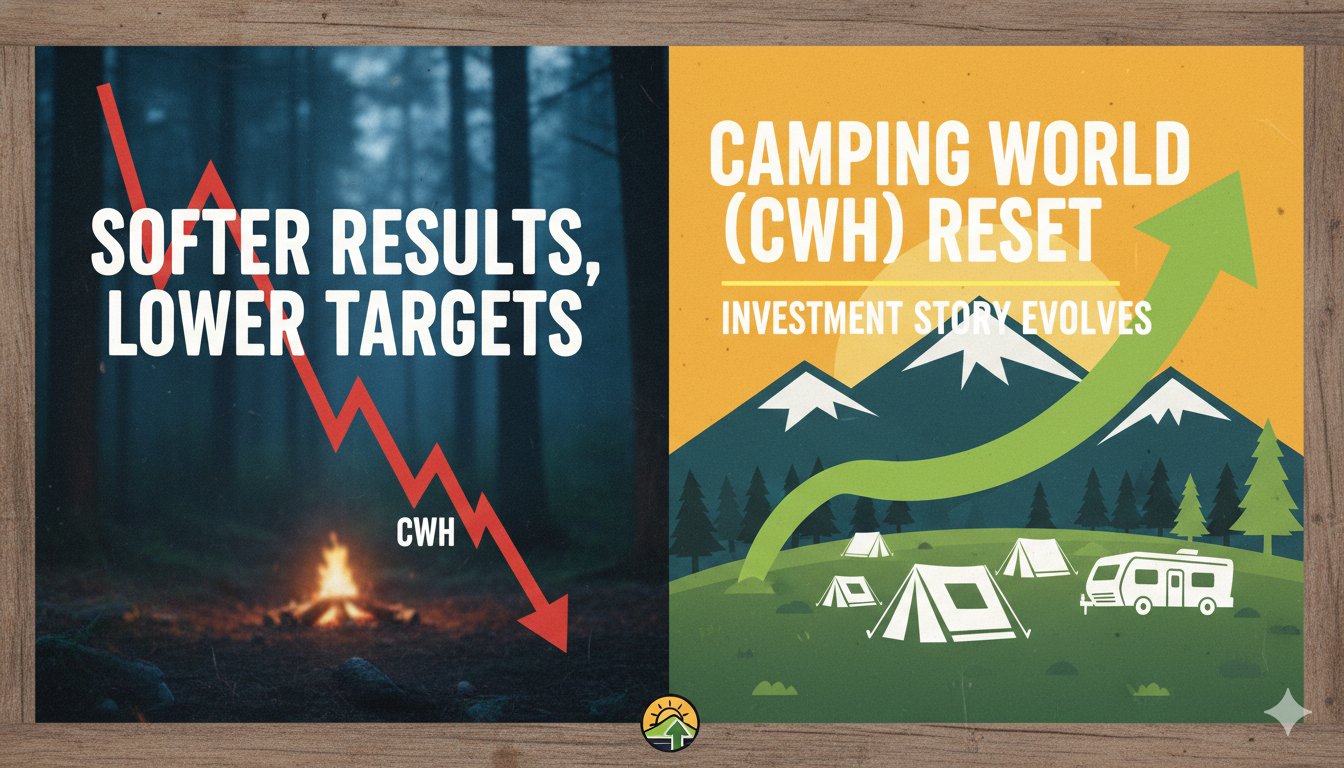
“Camping World Holdings reported softer Q4 2025 results with a wider adjusted loss and revenue down year-over-year, prompting analysts to slash price targets amid cautious 2026 guidance. Despite full-year adjusted EBITDA growth exceeding 35% and market share gains, near-term pressures from inventory clearance, margin compression, and deleveraging efforts—including a dividend pause—have reset expectations lower, with consensus targets clustering in the mid-teens and the stock trading near multi-year lows.”
Camping World Holdings: Navigating a Post-Peak RV Market Reset
Camping World Holdings, the nation’s largest recreational vehicle dealer, is undergoing a clear recalibration of its investment narrative following the release of fourth-quarter and full-year 2025 results. The company delivered a mixed performance that highlighted both operational progress and persistent headwinds in a normalizing RV industry.
For the fourth quarter ended December 31, 2025, revenue came in at approximately $1.17 billion, marking a 2.6% decline from the prior year but narrowly surpassing analyst expectations. New and used vehicle unit same-store sales volume rose 4%, helping the company maintain a combined market share of 13%. However, profitability deteriorated significantly. The adjusted EBITDA loss widened to $26.2 million from $2.5 million in the comparable period, driven by accelerated clearance of aged inventory and reserves related to insurance product cancellations. Adjusted diluted EPS landed at a loss of $0.73, missing consensus estimates and reflecting margin pressures that pushed operating margins to negative 4.3% from negative 1.3% a year earlier.
Full-year results painted a brighter picture on certain metrics. Revenue reached $6.4 billion, up 4.4% year-over-year, while adjusted EBITDA grew more than 35% to $242.9 million. The company highlighted strong momentum in Good Sam services and plans, with revenue up about 3% in the quarter, alongside used vehicle volume gains and cost reductions. Management pointed to roughly $25 million in annualized SG&A savings as evidence of disciplined expense management.
Yet the market reaction focused on the softer elements. Shares plunged following the report, reflecting investor disappointment with the Q4 miss, ongoing margin compression, and a strategic shift that included pausing the dividend to prioritize debt reduction. The company has repaid an additional $50 million in long-term debt in early 2026, underscoring a focus on strengthening the balance sheet amid elevated leverage levels.
Analysts have responded by lowering price targets across the board, signaling a reset in near-term expectations. Consensus now hovers around the mid-teens, with recent adjustments including:
Citi reducing its target to $15 from $18 while maintaining a Buy rating.
BMO Capital trimming to $16 from $22 but keeping an Outperform stance.
Roth Capital moving to $16 from higher levels.
Baird cutting to $11 from $15 with a Neutral view.
KeyBanc lowering to $12 from $18.
These revisions reflect caution over softer guidance for 2026, where adjusted EBITDA is projected in the range of $275 million to $325 million. Management noted that roughly half of the year’s EBITDA is expected in the first half, but flagged headwinds including an estimated $35 million impact from continued inventory optimization efforts, primarily weighted toward the front half of the year. Broader industry assumptions include new unit retail sales of 325,000 to 350,000 and used units between 715,000 and 750,000.
The RV sector continues to face normalization after pandemic-era demand surges. New vehicle average selling prices are expected to stabilize around $39,000 to $40,000, with used ASPs near $31,500. Blended gross margins face pressure of 120 to 130 basis points, though management anticipates gradual improvement as inventory actions conclude.
Key Financial Metrics Comparison
| Metric | Q4 2025 | Q4 2024 | Change | Full Year 2025 | Full Year 2024 | Change |
|---|---|---|---|---|---|---|
| Revenue | $1.17B | $1.20B | -2.6% | $6.4B | $6.13B | +4.4% |
| Adjusted EBITDA | -$26.2M | -$2.5M | Widened loss | $242.9M | $178.8M | +35.8% |
| Adjusted Diluted EPS | -$0.73 | N/A | Miss | N/A | N/A | N/A |
| Net Loss | -$109.1M | N/A | Increased | -$105.6M | N/A | Increased |
| Cash & Equivalents (end of Q4) | $215M | N/A | N/A | N/A | N/A | N/A |
| Long-Term Debt | $1.472B | N/A | N/A | N/A | N/A | N/A |
The deleveraging priority remains central. With cash at $215 million at quarter-end and ongoing debt repayments, the company aims to reduce leverage ratios meaningfully over the coming years. This conservative stance may limit near-term shareholder returns but positions the business for greater resilience in a cyclical industry.
Good Sam continues to serve as a stabilizing force, with consistent growth in services and membership revenue providing higher-margin, recurring income streams less exposed to vehicle sales volatility.
As the RV market digests post-boom dynamics, Camping World’s scale, market share leadership, and cost discipline offer potential advantages. However, the path to recovery hinges on executing inventory clearance without prolonged margin erosion, stabilizing vehicle demand, and delivering on the lower end of the 2026 EBITDA range. Investors are now weighing whether the reset creates an entry point or signals deeper structural challenges in the sector.
Disclaimer: This article is for informational purposes only and does not constitute investment advice, financial recommendations, or a solicitation to buy or sell securities. Investing involves risk, including potential loss of principal.