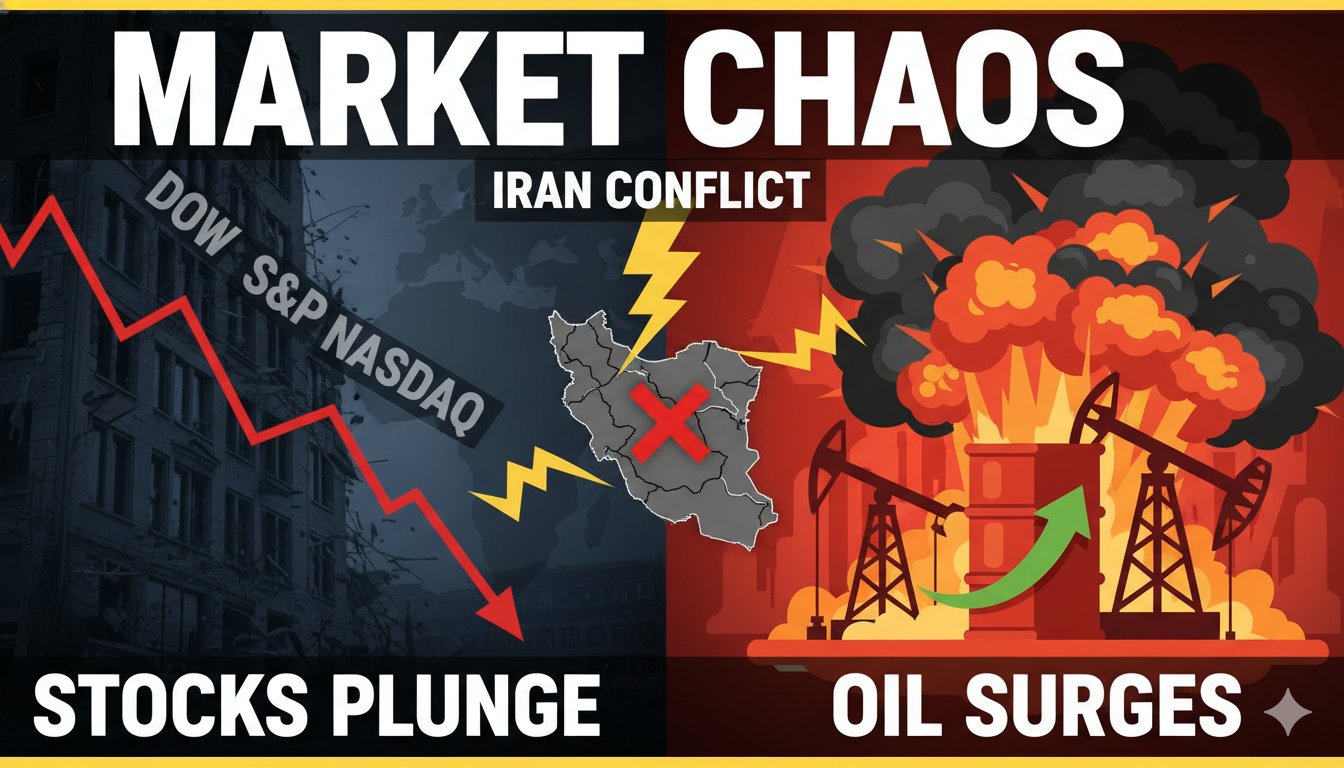
Stock Market Today: Dow, S&P 500, Nasdaq Futures Sink While Oil Prices Surge as Iran Conflict Rattles Markets
“U.S. equity futures plunged in premarket trading as geopolitical tensions in the Middle East intensified, with Dow futures dropping over 600 points, S&P 500 and Nasdaq contracts sliding sharply, and crude oil benchmarks surging 7-13% on fears of supply disruptions through the Strait of Hormuz following U.S. and Israeli strikes on Iran.”
U.S. stock futures opened sharply lower Monday as markets digested the rapid escalation in the Middle East conflict involving U.S., Israeli, and Iranian forces. The dramatic military developments over the weekend, including strikes that targeted key Iranian leadership and infrastructure, have triggered a classic risk-off move across global assets. Investors are fleeing equities in favor of safe havens while energy markets price in severe threats to global oil supply chains.
Dow Jones Industrial Average futures were down more than 600 points in early trading, reflecting a potential opening decline of around 1.2-1.3% from Friday’s close near 49,000. This follows a session where the Dow itself shed over 500 points in recent regular trading amid building concerns. S&P 500 futures declined around 1.1%, pointing to an implied open roughly 20-80 points lower, while Nasdaq-100 futures fell steeper, down 1.4% or more in some quotes, as tech stocks proved particularly vulnerable to rising uncertainty.
The primary driver behind the sell-off stems from fresh fears that the conflict could disrupt crude flows through the Strait of Hormuz, the narrow chokepoint responsible for roughly 20% of the world’s seaborne oil trade. Reports indicate tanker traffic has effectively halted in parts of the Gulf, with multiple vessels attacked or anchored amid the chaos. This has sent oil prices rocketing higher in a rush of geopolitical risk premium.
West Texas Intermediate (WTI) crude futures climbed around 8%, trading near $72 per barrel after briefly pushing toward $75 in early moves. Brent crude, the global benchmark, surged even more aggressively, jumping as much as 13% to top $82 before settling around $79-80, marking multi-month highs not seen since early 2025. These gains represent the sharpest single-day moves in oil in years, underscoring how quickly sentiment shifted from cautious optimism to outright supply disruption alarm.
Energy stocks have provided one of the few bright spots amid the broader equity weakness. Major integrated players like Exxon Mobil and Chevron posted modest gains in premarket, while exploration and production names saw stronger advances as higher crude supports their revenue outlook. However, these isolated pockets of strength have done little to offset the widespread retreat in risk assets.
The conflict’s implications extend beyond immediate price action. A prolonged disruption in the Gulf could exacerbate inflationary pressures already lingering in the U.S. economy, potentially complicating the Federal Reserve’s path on interest rates. Higher energy costs feed into transportation, manufacturing, and consumer goods, raising the specter of sticky inflation just as markets had begun pricing in softer policy ahead.
Safe-haven flows have accelerated in response. Gold prices advanced as investors sought protection from volatility, while U.S. Treasury yields dipped modestly on flight-to-quality buying. The U.S. dollar strengthened against major currencies, adding further pressure on multinational exporters in the S&P 500.
Market participants are closely monitoring developments for signs of de-escalation or further expansion. While some analysts suggest the risk premium in oil could prove temporary if shipping resumes quickly, others warn of sustained higher levels—potentially $80-90 for Brent—if facilities remain offline or retaliatory actions intensify. Defense stocks have also benefited from the heightened security environment, with aerospace and military contractors seeing bid interest.
Broader equity sectors reflect the defensive posture: consumer discretionary and technology names, sensitive to economic slowdown fears, led declines in futures, while utilities and staples held up relatively better. Small-cap Russell 2000 futures mirrored the weakness in larger indexes, down sharply as higher funding costs and uncertainty weigh on growth-oriented companies.
The session ahead promises high volatility as traders react to any overnight headlines from the region. With Iran as OPEC’s fourth-largest producer and the Strait of Hormuz critical to global flows, even brief interruptions carry outsized market impact. Investors remain positioned for whipsaw moves, balancing the potential for a swift resolution against the very real threat of broader regional instability.
Disclaimer: This is general market commentary based on current conditions and should not be construed as investment advice, personalized recommendations, or a guarantee of future performance. Always conduct your own research and consult professionals before making financial decisions.