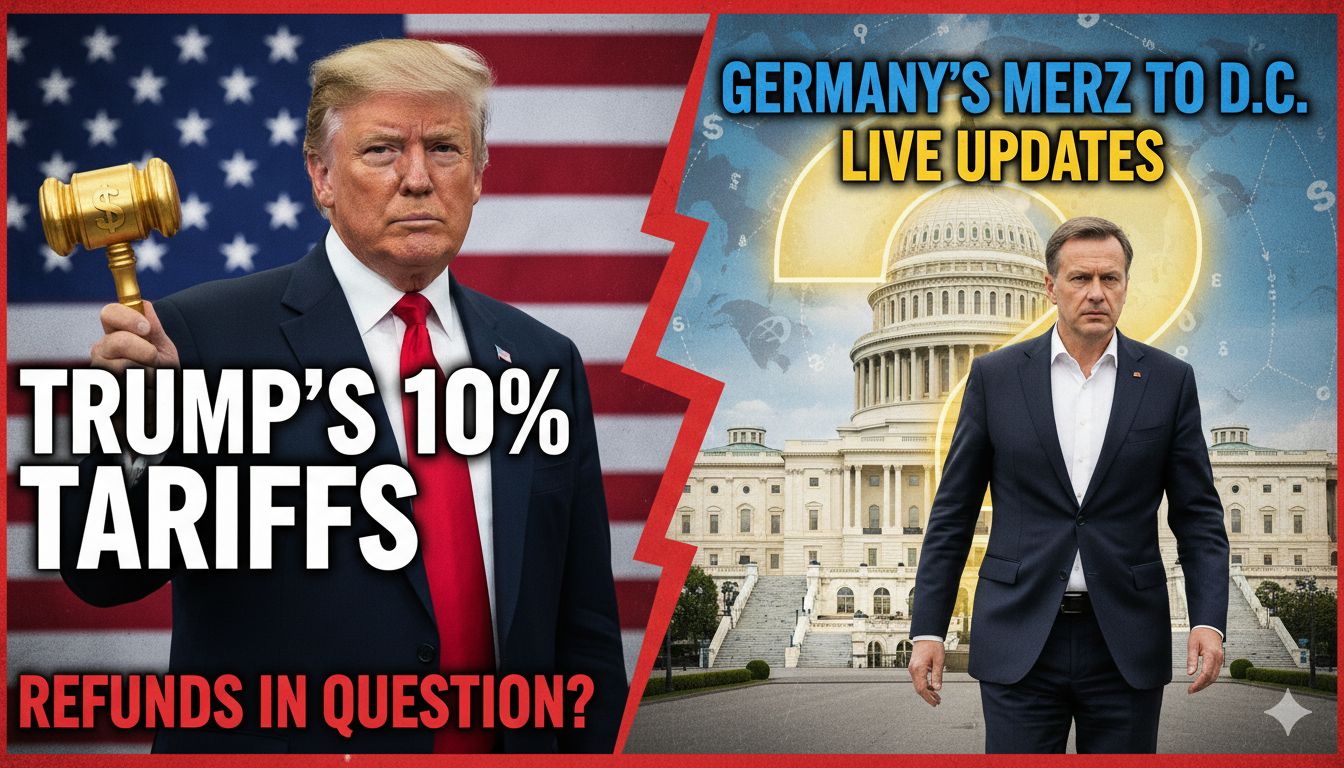
“German Chancellor Friedrich Merz met with President Donald Trump in Washington as the new 10% global import tariffs, implemented following a Supreme Court ruling limiting prior measures, remain in full effect. Discussions centered on trade tensions, potential refunds for affected importers, the ongoing Iran conflict overshadowing economic talks, and broader transatlantic issues like Ukraine support, with no immediate concessions on tariff relief announced.”
Trump Tariffs Live Updates: Germany’s Leader Merz to Visit Washington with Trump’s 10% Tariffs in Effect, Refunds in Question
The high-stakes White House meeting between President Donald Trump and German Chancellor Friedrich Merz unfolded against a backdrop of escalating global tensions and persistent trade frictions. Originally planned to address the implications of the recently enacted 10% global tariffs on imports, the agenda shifted significantly due to the ongoing U.S.-Israel military operations against Iran, which dominated much of the conversation.
The tariffs, imposed via executive action under Section 122 of the Trade Act following the Supreme Court’s decision invalidating broader uses of emergency powers for sweeping duties, took effect on February 24 at a baseline rate of 10% on most imports not covered by exemptions. This move came after the administration initially signaled a potential hike to 15%, though it settled at the lower level for now. Exemptions apply to critical areas such as certain minerals, energy products, pharmaceuticals, agricultural staples like beef and oranges, and specific vehicles and aerospace components to mitigate domestic economic disruptions.
For Germany and the broader European Union, these duties add pressure on key export sectors, particularly automobiles, machinery, and chemicals, which form the backbone of transatlantic trade. German exporters face increased costs that could translate to higher prices for U.S. consumers or squeezed profit margins abroad. The EU has paused ratification of pending trade agreements with the U.S., demanding greater predictability and clarity on future tariff directions before advancing bilateral economic pacts.
During the Oval Office discussions, Trump defended the tariffs as a tool that has enriched the United States and rebalanced trade relationships in favor of American workers and manufacturers. He described them as making the country “very rich” and even joked about applying them forcefully to Germany, while maintaining a cordial tone toward Merz, whom he called a friend and praised for doing a “really great job.” No concrete commitments emerged to roll back or exempt European goods from the duties, leaving German officials to emphasize the mutual harm tariffs inflict, particularly on consumers in the imposing country.
Merz, in his second White House visit since assuming the chancellorship, sought assurances on trade stability amid the new regime. He highlighted Germany’s preference for adhering to existing EU-U.S. tariff understandings, including caps agreed upon earlier, to foster predictability. The chancellor also underscored the need for continued U.S. alignment on supporting Ukraine against Russian aggression, framing transatlantic unity as essential despite divergences on trade policy.
The Iran conflict cast a long shadow over the economic dialogue. As the first European leader to visit Washington since the escalation of U.S.-Israeli strikes, Merz expressed Germany’s support for partners while reiterating Berlin’s non-participation in military actions. Discussions touched on regional implications, post-conflict scenarios, and the importance of international law, though these topics largely sidelined deeper tariff negotiations.
A lingering question for businesses and importers revolves around potential refunds for duties collected under previously invalidated tariff regimes. The Supreme Court’s ruling raised expectations among some importers that overpaid amounts could be reclaimed, but no clear mechanism or timeline has been established by the administration. This uncertainty compounds challenges for companies navigating compliance, supply chain adjustments, and pricing strategies in an environment where tariffs remain fluid and subject to potential future modifications.
Broader market reactions reflect investor caution. Equity indices in export-heavy sectors have shown volatility, with automotive and industrial firms monitoring the talks closely for any signals of de-escalation. Meanwhile, the administration continues to position tariffs as a temporary measure—initially set for 150 days under the current framework—to address perceived international payment imbalances and trade deficits.
The meeting highlighted the delicate balance in U.S.-German relations: strong personal rapport between the leaders contrasted with structural disagreements on trade tools and geopolitical priorities. As the tariffs persist, European leaders like Merz will likely continue pushing for dialogue to minimize disruptions while safeguarding strategic alliances on security matters.
Disclaimer: This is a news report based on current developments in U.S. trade policy and international diplomacy. It does not constitute financial, investment, or legal advice.